
Bird - Case Study
Duration : 16 Weeks
A strategic intervention developed in partnership with Bird, a leading micromobility provider, to address pervasive challenges in e-bike parking and user behavior. The project, stemming from a New School partnership, identified significant issues including widespread parking non-compliance, pedestrian frustration, and high operational costs associated with fleet management
Role
Service Design
UX Research
Ethnographic Research
Tools
Miro, Figma
Abobe Illustrator
Adobe Photoshop
Industry
Micro-mobility
Electric Vehicle
Public Space Design
Service Type
Nudges & Zoning System
AI Photo Validation
Emotional Connect

From Chaos to Cohesion:
Interventions in E-Bike Parking
nexus
Kavya Raj (Me) | Apoorba Nayak | Kareena Vaswani | Rohit Gavali
BACKGROUND
BACKGROUND
Life of a Shared Bike beyond a Trip.
The bike has a life of its own- beyond just a trip.
It should be happy, healthy and comfortable to be able to serve well!
WHAT WE ARE ADDRESSING?
How might we nudge users into good behavior so they park well and help prevent overcrowding of corrals during peak times?
HOW WE ARE ADDRESSING?
Leverage behavioral economics and digital nudges
Incentivize responsible parking
Use data to reducing congestion and operational costs
Optimise built environments for rider and pedestrian behaviour
FIELD RESEARCH
Parking Behaviour and Interviews
We did multiple field research to gather insights of user behaviours and preferences. Through on-site observations, product testing, and interviews with pedestrians and riders, we collected valuable data. This overview sets the for detailed findings on user interactions and experiences with Bird's products.


LOCATION: FLUSHING, JAMAICA (BROOKLYN,NY) and GRAND CENTRAL (MANHATTAN)
1
Environment
-
People felt that there were lack of designated spots for parking
-
Limited Bike Lanes
-
Lack of sufficient supporting infrastructure
2
Service & App
-
Confusing on App Onboarding
-
Lack of Informed systems
-
Subpar Digital integration
-
Missing phone stands
-
No Shock Absorbers in bikes/scooters
3
Public Views
-
Irritation among public due to obstruction
-
Irresponsible handling of public spaces
-
Hesitation to have bike and scooter infra in the area
ECOSYSTEM
City Planning Vs Competitors
We analyzed public policies across different cities to assess government support for shared micro-mobility, including regulations, funding, and incentive programs that promote affordability and accessibility. Alongside this, we evaluated competitor practices to identify key lessons and adoption challenges relevant to a brand like Bird, while also examining public attitudes toward shared micro-mobility systems.
City Initiatives


Competitive Brands

.png)

Key Insights
Every 1% improvement in proper parking saves significant in ops costs
In New York City's East Bronx, 24% of inspected e-scooters were improperly parked
Parking area density accounts for 85% of parking non-compliance
Riders ignore signs, corral markings aren’t enough, and enforcement is expensive.
IDEATION


AREAS OF INTERVENTIONS
The Built Environment
Corral behaviour and physical infrastructure of bike docking system. When people see good parking, they mimic it.
Nudges and Incentives
Incentivizing fleet management for ideal bike distribution around the City. Assisting the independent behaviours to learn habits
Digital Layer Translation
Pre-determing the end location for better assistance. Validating Parking and ride completion through AI Image scanning model.
IDEA TESTING
Built on behaviour, backed by testing


We ran an in-person mock bike parking tests with 25+ individuals to understand public's corral behaviour in different scenarios
Testing Scenario: Participants were given a city neighbourhood map printed on a 'Arch E' size paper, a toy bike, a to-do statement, some assisting notification cards and a parking ticket.
Participants were asked to travel from destination A to destination B while running some errand in between, in which they had to park their bike multiple times where they were assisted through assistive notifications and if they happened to park incorrectly they were also given a penalty ticket.
We ran an in-person mock bike parking tests with 25+ individuals to understand public's corral behaviour in different scenarios

Key Takeaways
Multi- Coloured corrals were attractive but, confused riders.
Participants were parking correctly in the areas where there were correclty parked bikes already
Straight parking lines preferred due to clarity, space efficiency, and easy bike alignment.
Nudges assisted participants,
helped them park the bikes properly.
PROTOTYPES
Corral Layout & Docking System
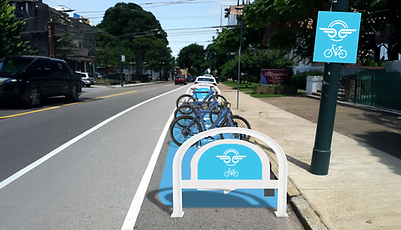
Clear, bright blue corrals near sidewalks or bike lanes make parking areas easy to identify from a distance. Directional arrows guide proper parking for efficient space use, while a simple docking system keeps bikes upright during wind or storms. This low-cost solution improves safety, reduces damage, and extends bike lifespan.


Bird Avatars
The bike has a life of its own- beyond just a trip. It should behappy, healthy and comfortable to be able to serve well! Introducing Bike Personality- Ellie as a bird avatar in the Bird apps to keep the participants more engaged & connected to the Bird Micro-mobility system.
Bikes Avatars express emotions, from happy to annoyed, based on how they’re treated
This turns a simple trip into a relationship &
encourages care and connection.
Bikes compete on a scoreboard, earning points for responsible parking.


Parking Incentive


WIREFRAMES
From Chaos to Cohesion

High Fidelity
Destination Navigation & Parking Zone Selection


Nudges for Parking Right


